
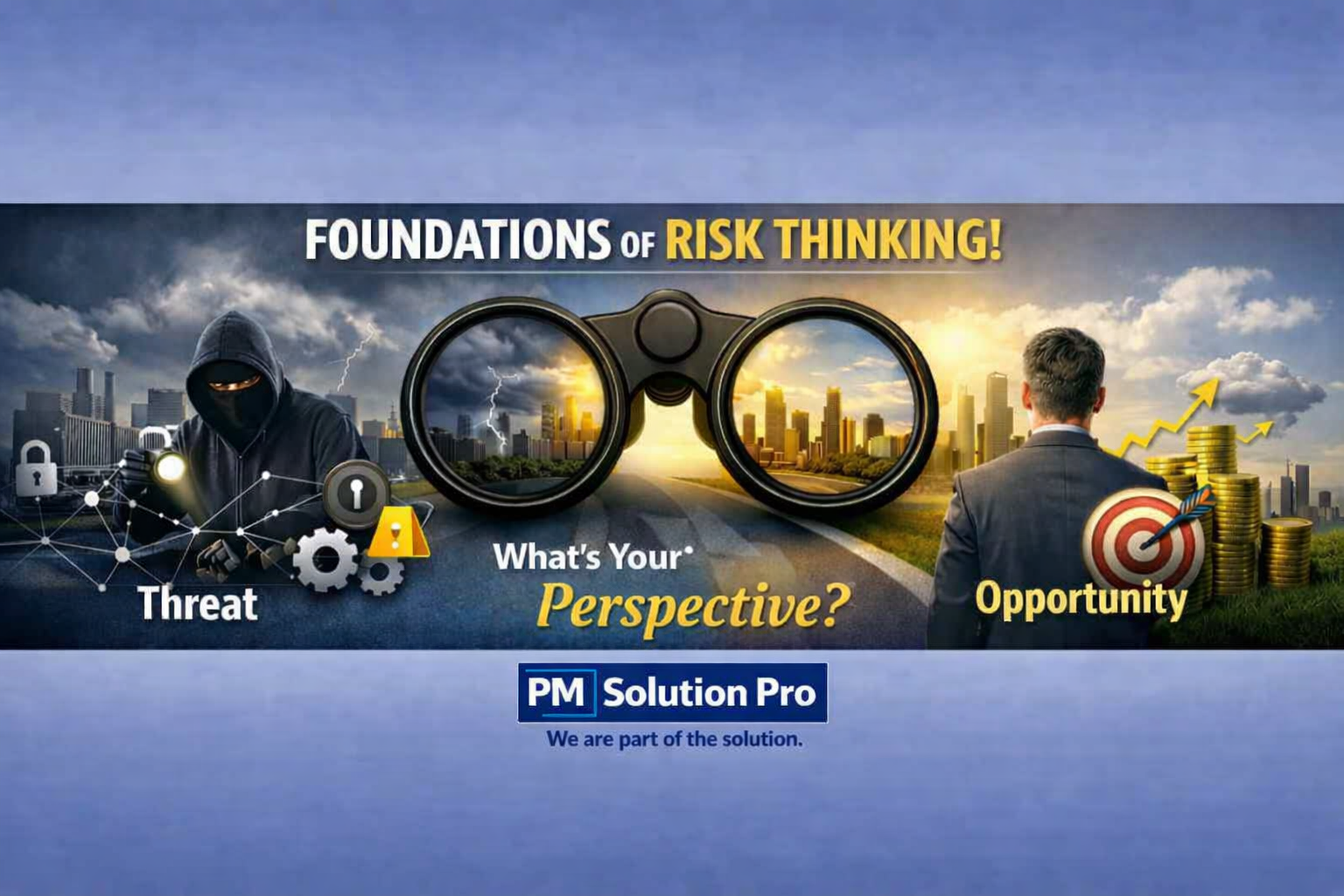
Before we go deeper into our risk foundation topic, I want us to see risk thinking as a single, connected discipline, not a collection of separate terms. In accepted risk management practice, risk is understood through its relationship to objectives: something uncertain may happen in the future, and if it does, it may affect what we are trying to achieve. That is why good risk thinking starts with clear identification.
We first ask, “What uncertainty could affect our objective?” Then we sharpen the answer by separating the cause, the event, the trigger, the probability, the impact, and the resulting severity. I also want us to keep one important thought in mind: risk is not only a product of probability and impact; it is also influenced by time. A risk assessment without a time boundary is often incomplete, because probability, consequences, urgency, and available response options can all change over time.
A simple example makes this clearer. Asking, “What is the probability of snow?” is not a complete risk question. Asking, “What is the probability of snow in the next two hours while the fleet is traveling between Calgary and Edmonton?” provides a useful time frame, objective, and decision context.
The same applies to supplier delays, cybersecurity weaknesses, safety exposures, or weather-dependent field activities. The cause explains why the risk exists; the event explains what may happen; the trigger gives us a warning; probability tells us how likely the event is within a defined context; impact tells us what consequence may follow; and severity helps us judge how much attention the risk deserves. Time gives all of these parts practical meaning because an early warning may preserve choices, while late discovery may leave only costly recovery.
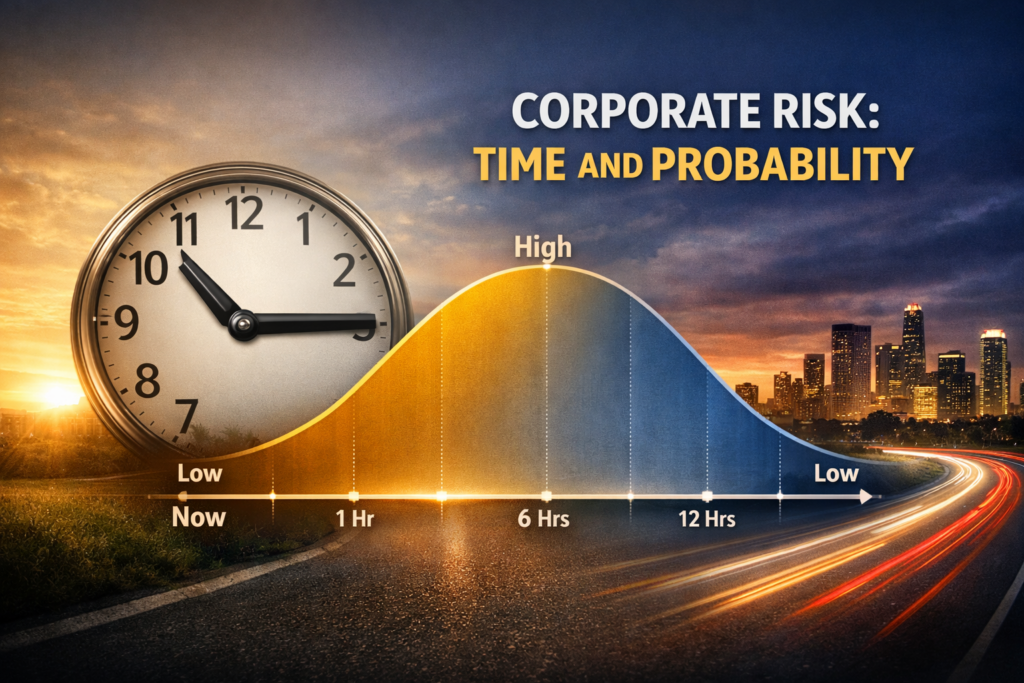
My message to the reader is simple: do not rush to rate a risk before you understand its story. Identify the risk in relation to an objective, explain the cause without blame, define the event as something uncertain, set triggers that can be observed, assess probability using the best available information and time horizon, describe impact in terms that matter to the business or project, and use severity to decide the right level of attention.
Also remember the practical idea behind Risk Relativity Theory: risk is relative to the objective, interest, position, and point of view of the observer. The same uncertainty may be a threat to one party and an opportunity to another; a strong security system may threaten a thief while helping the owner and the security guard. It is why professional risk assessment must be clear about whose objective is being protected and whose perspective is being used.
Once the uncertain event actually happens, it is no longer only a risk; it becomes an issue, problem, incident, benefit, or opportunity realized. This approach keeps risk management structured, evidence-informed, proportionate, and useful for practitioners who must make decisions before certainty arrives.
Reference: Adapted from Frago, R. C., “Risk as a Function of Time,” LinkedIn article; and related concepts from Risk-Based Management in the World of Threats and Opportunities and earlier risk management writings by the author.
With that foundation in mind, the first practical step is to identify risks. Before we can discuss causes, events, triggers, probability, impact, or severity, we must first clearly name the uncertainty so others can understand it. This is where the risk conversation begins: not with scoring, not with response planning, and not with fear, but with the simple discipline of asking what could affect the objective, why it matters, and whether it is worth bringing into view before time takes away our options.
#RiskManagement #CorporateRisk #StrategicThinking #BusinessResilience #PMSolutionPro
About the Author
Rufran C. Frago, P. Eng., PMP, CCP, PMI-RMP, aka. UPANOG is the Founder of PM Solution Pro and KATHAKO, trade names (trademarks) of Risk-based Management and Services Inc., a Canadian company focusing on project/business risk-based management consulting, business development, creative products, and training services. Risk-based Management Professional, Planner & Scheduler, and Project Control Specialist with over 30 years of extensive experience delivering large-scale projects in O&G, LNG, Utilities, Refining, Power, Renewables, Nuclear, T&D, Oleochemicals, Petrochemicals & Manufacturing sectors.
As UPANOG, he sidesteps the purely technical and assumes an imaginative persona: a children’s book author and digital creator who values the finer things in life. He recognizes the power of storytelling and illustrations to impart important life lessons to children and kids at heart. Whether it’s kindness, empathy, resilience, or understanding diversity, he knows these themes often find their way into children’s literature. Young readers learn as these lessons are seamlessly woven into the narratives, while enjoying captivating stories.

Visit our website: www.pmsolutionpro.com
Continuing the Spirit of Learning
In that same spirit of continuing education, we invite readers to explore PM Solution Pro and KATHAKO, where we offer e‑Learning and self‑study courses for continuing education and professional advancement.
Click the image below and you’ll be transferred to our learning website.

Visit us at www.pmsolutionpro.com and www.kathako.com.
BOOKS AUTHORED BY RUFRAN FRAGO (Available on Amazon)
- Risk-based Management in the World of Threats and Opportunities: A Project Controls Perspective
- Plan to Schedule, Schedule to Plan
- How to Create a Good Quality P50 Risk-based Baseline Schedule
- Schedule Quantitative Risk Analysis (Traditional Method)
- RISKY RHYMES: A POETIC GUIDE TO RISK-BASED MANAGEMENT (For Teens, Students, and Management Professionals)
- Unit Cost Estimation Guide – Steam Power Plant Operating Budget
